Disc Filter · Filtration

GreenDisc
Disc Filter

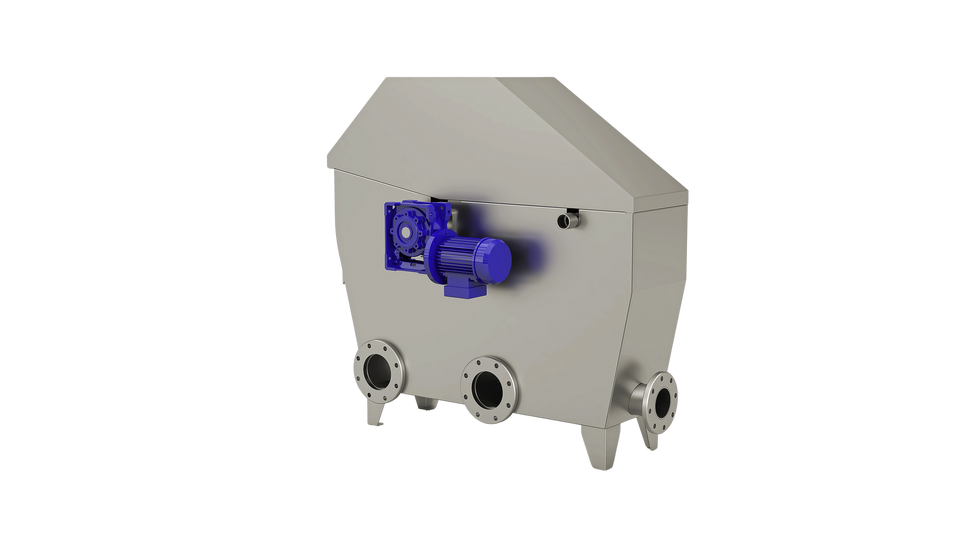
A rotary disc filter built for the tannery. Connected to the drums, the GreenDisc continuously filters tanning baths — separating fibres, removing dust and shaving residues and dewatering sludge, all with self-cleaning discs and quick-change meshes.

AISI 304 / 316 Stainless
Self-Cleaning Discs
8–15 m³/h
CE 2006/42/EC
View Models Request Quote →
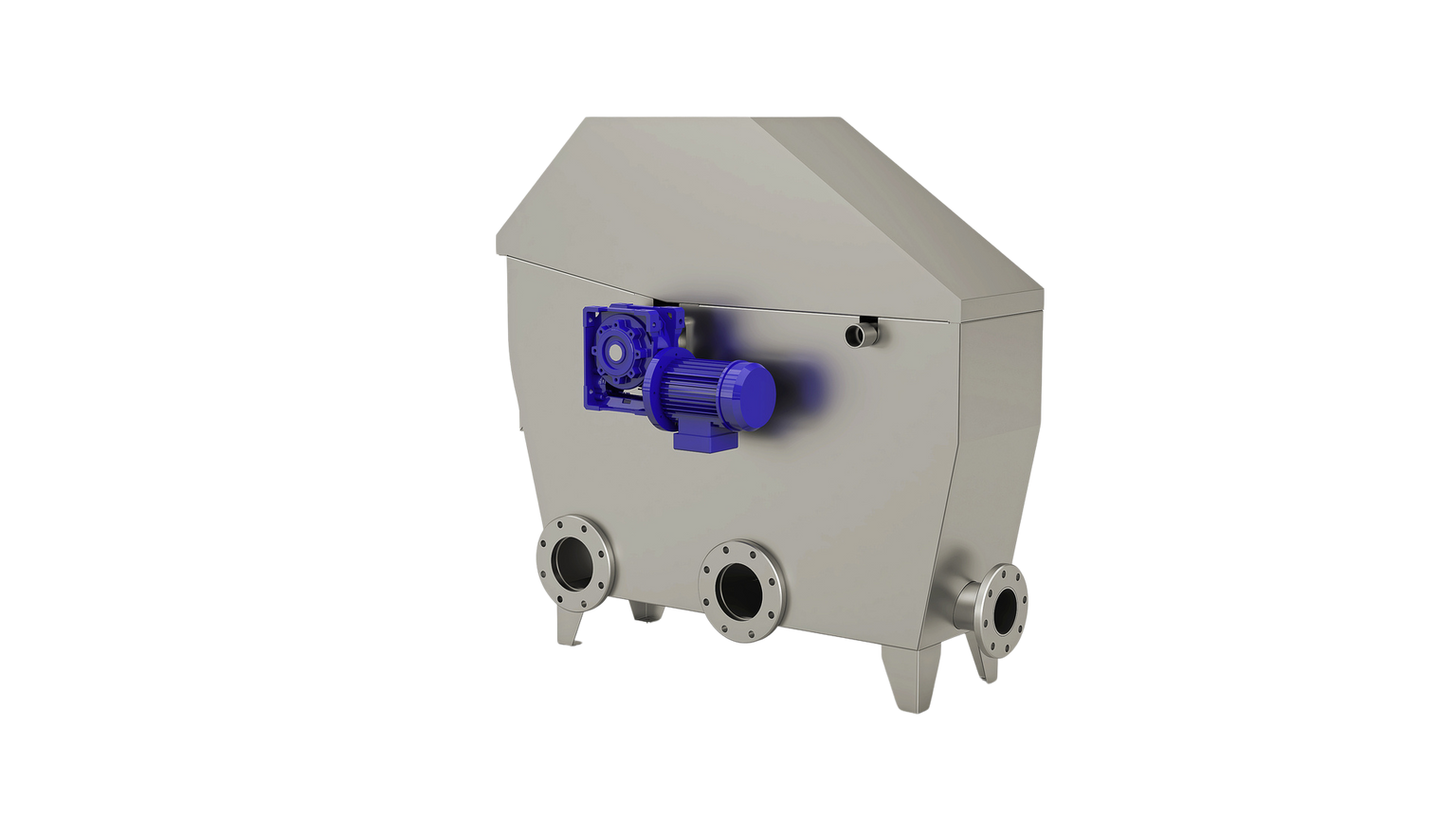
GreenDisc rotary disc filter for tanneries — AISI stainless steel body with geared drive motor and flanged inlet and outlet ports
Made in Italy

Three Filters,
Three Jobs

Kymera covers the full filtration line — from coarse screening at the channel, through continuous bath filtration, to final sludge dewatering. Pick the stage you need.

GreenDisc rotary disc filter
01Tanning-Bath Filtration

Disc Filter

Rotary disc screen for continuous in-line filtration of tanning baths — fibre separation and sludge dewatering.

Explore →
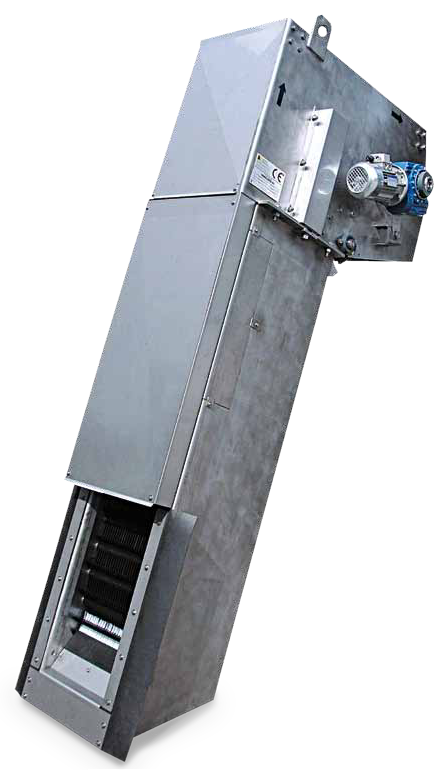
Self-cleaning belt screen
02Coarse Screening

Belt Screen

In-channel self-cleaning bar screen that holds back the coarse solids in civil and industrial wastewater.

Explore →
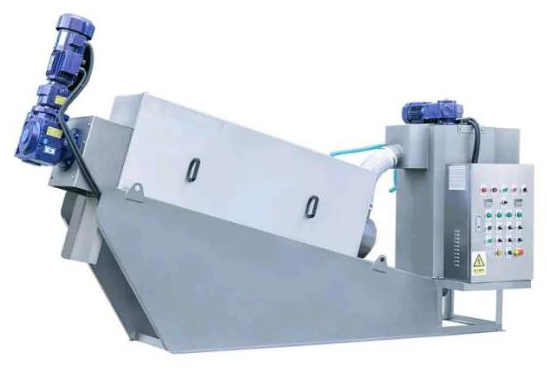
K401 continuous mud filter press
03Sludge Dewatering

Mud Filter Press

Compact continuous screw press that dewaters sludge in-line — low energy, low chemicals, self-cleaning.

Explore →
Disc Filter·Tanning Bath Filtration·Fibre Separation·Sludge Dewatering·Shaving Residue Removal·Self-Cleaning·Quick-Change Meshes· Disc Filter·Tanning Bath Filtration·Fibre Separation·Sludge Dewatering·Shaving Residue Removal·Self-Cleaning·Quick-Change Meshes·

Continuous Solids
Filtration for Tanneries

The GreenDisc is a disc filter — a machine for the filtration of solids that is particularly suited to separating fibres and dewatering sludge. It was developed specifically for the tannery industry.

Applied to the drums, it filters the tanning baths in continuous operation, removing the solid residues, the dust and the shaving residues that would otherwise overload downstream treatment and waste valuable bath water.

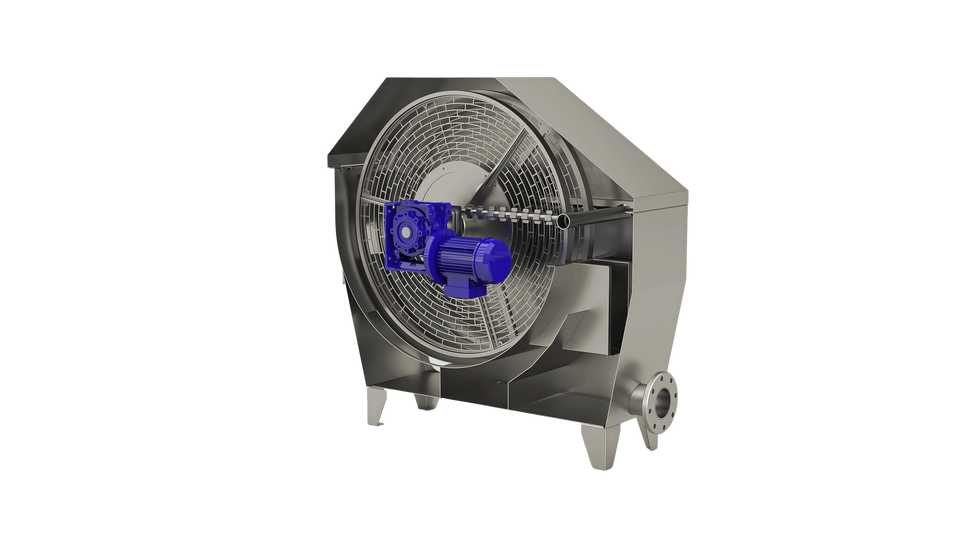
Cutaway view of the GreenDisc disc filter showing the internal rotating filtering disc and mesh inside the stainless steel tank

How the Disc
Filter Works

01

Feed

The effluent enters the feeding compartment and flows into the space between the filtering discs.

02

Filtration

It passes through the mesh into the discharge compartment, while the solids stay on the disc's filtering surface.

03

Self-Cleaning

As solids build up they agglomerate and, with the discs rotating, scrape along the surface — a continuous self-cleaning effect.

04

Auto-Discharge

Once retained solids exceed a set volume the machine discharges them automatically; counter-wash nozzles keep the meshes clean.

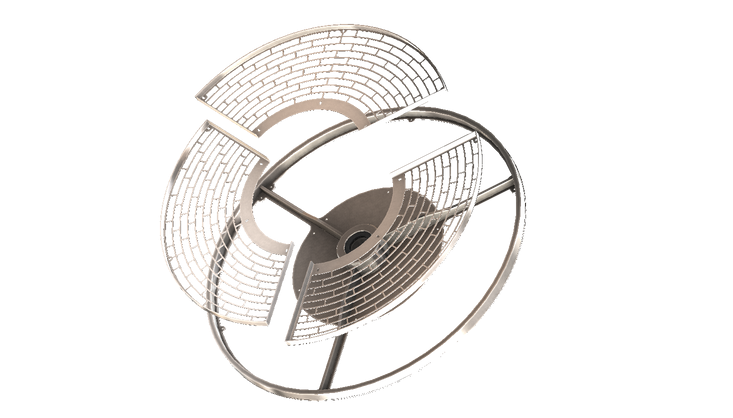
GreenDisc filtering disc with quick-change meshes divided into three 120-degree segments that can be removed individually

Built for Fast,
Clean Maintenance

01

Quick-Change Filtering Meshes

The meshes are split into three 120° segments and can be removed individually — without taking the disc off the machine — for fast, low-cost maintenance.

02

Quick-Change Disc Gaskets

The disc gaskets use the same rapid-change system, cutting downtime when seals need replacing.

03

Contamination-Safe Tank

The tank is engineered so that, if a gasket fails, dirty water cannot reach the clean water — protecting the filtrate.

04

Stainless Steel & Selectable Mesh

Built in AISI 304 or AISI 316 to suit your process, with the filtration mesh aperture chosen to match your requirements. Certified to Machinery Directive 2006/42/EC.

Two Models

GreenDisc 802 disc filter — 8 cubic metres per hour stainless steel unit

GreenDisc 802

8 m³/h
Flow rate8 m³ / hour
Dimensions (W×D×H)1350 × 660 × 1250 mm
ConstructionAISI 304 / AISI 316
Mesh apertureOn request
CertificationCE 2006/42/EC
GreenDisc 1002 disc filter — 15 cubic metres per hour stainless steel unit

GreenDisc 1002

15 m³/h
Flow rate15 m³ / hour
Dimensions (W×D×H)1450 × 660 × 1350 mm
ConstructionAISI 304 / AISI 316
Mesh apertureOn request
CertificationCE 2006/42/EC

GreenDisc vs
Conventional Filters

 
CM GreenDisc
Other Brands
Maintenance
Easy and fast, with machine downtime kept to a minimum.
Long and difficult, with downtime and high costs.
Disc Gasket Replacement
Rapid, simple quick-change system.
Difficult, and needs the machine to be dismantled.
Footprint
Compact, with reduced bulk and optimised working volumes.
Bulkier, with working volumes often unsuited to the job.
Water Safety
Exclusive separation of unfiltered water to prevent contamination.
High contamination risk if the gaskets fail.

Where It Works

01

Tanning Baths

Continuous in-line filtration of the tanning liquors circulating to and from the drums.

02

Fibre Separation

Separates leather fibres carried in the baths, protecting pumps, pipework and treatment plant.

03

Sludge Dewatering

Dewaters the separated solids, reducing the volume and weight of sludge sent for disposal.

04

Shaving Residues

Removes shaving residues and dust released during processing before they reach the next stage.

05

Water Recovery

Cleaner bath water can be recovered and recirculated, lowering water and chemical consumption.

06

Discharge Compliance

Lightens the load on downstream purification so discharge stays within environmental limits.

Two self-cleaning belt screen filters installed in line, stainless steel bodies with inclined filtering belts
Also on this line · Filter type 02

Belt ScreenSelf-Cleaning

A second filtration principle for the heavy end of the process: an in-channel, self-cleaning belt screen that holds back the coarse solids from civil and industrial wastewater before they reach finer filtration or downstream treatment.

In-Channel Install
AISI 304 / 316L Stainless
Self-Cleaning Belt + Brush
CE 2006/42/EC
Belt Screen·Coarse Solids Separation·In-Channel·Self-Cleaning Belt·Rotating Brush·Acetal Resin Elements·Double-Belt up to 2500 mm· Belt Screen·Coarse Solids Separation·In-Channel·Self-Cleaning Belt·Rotating Brush·Acetal Resin Elements·Double-Belt up to 2500 mm·

Coarse-Solids
Screening in Channel

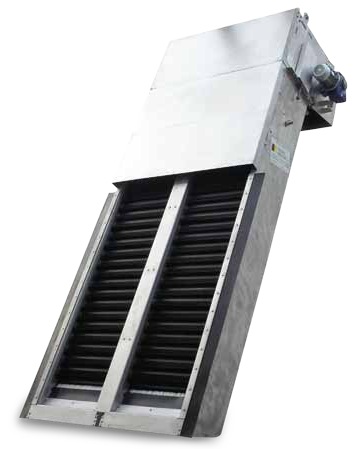
The belt screen is a self-cleaning bar screen designed for installation directly in the channel. It retains the coarse solids carried by water from intakes, civil treatment plants and industrial sewage systems.

It stops the bulky waste that cannot be discharged downstream — material that would otherwise foul the finer filtration stages or damage the components of the treatment plant further along the line.

Self-cleaning belt screen in stainless steel with side-mounted gearbox and inclined filtering belt for in-channel installation
≤1200 mm
Single-Belt Channel
One filtering belt covers channels up to 1200 mm wide.
≤2500 mm
Double-Belt Channel
Two units paired on a central support span channels up to 2500 mm.
304/316L
Stainless Throughout
Frame and components in AISI 304–316L; acetal-resin filtering elements.

How the Belt
Screen Works

01

Screen

Water flows through the inclined belt of acetal-resin filtering elements, which capture the coarse solids on the surface.

02

Lift & Transfer

The moving belt drags the retained solids up and out of the liquid surface, carrying them toward the discharge chute.

03

Self-Clean

The elements clean each other as the belt advances, and a rotating brush turning against the belt completes the cleaning.

04

Closed Discharge

Reversing the belt direction releases the solids into a fully closed hopper, feeding a collection tank or compaction system.

Front view of the belt screen filtering surface showing the acetal-resin elements and the double-belt arrangement

What Makes It
Different

01

Acetal-Resin Filtering Element

The filtering elements are shaped acetal resin — highly resistant mechanically and chemically, non-photosensitive, and able to work at both high and low temperatures.

02

Brush Driven by the Belt Itself

A chain-and-sprocket take-off from the belt drive shaft spins the counter-rotating cleaning brush — no extra gearmotor, so the machine saves energy.

03

Double-Belt for Wide Channels

A single belt handles channels up to 1200 mm; for wider channels two units pair on one central support, reaching up to 2500 mm.

04

Fixed Shaft, Separate Tensioner

The belt is tensioned by trapezoidal-thread screws on slides while the drive shaft stays fixed — a more solid arrangement than conventional builds.

05

Removable Head

The upper part lifts off the channel-anchored frame in a few steps, so major maintenance is done without pulling the whole screen out of the channel.

Different Fields,
Same Efficiency

Civil Sector
Civil wastewater treatment plants Water pumping & lifting stations
Industrial Sector
Tanning industry Paper mills Dairies & sugarhouses Food industry Food-preserving industry Chemical & petrochemical Textile industry Industrial laundries Slaughterhouses Zootechnical breeding
Also on this line · Filter type 03

Mud Filter
PressContinuous

A compact, energy-efficient screw press for in-line sludge dewatering. Unlike a traditional batch filter press, it runs in continuous flow — no sedimentation silos, no downtime for cleaning, no manual intervention.

Continuous & In-Line
From 2 kWh
10–25 m³/h
Self-Cleaning
Continuous mud filter press for sludge dewatering — stainless steel screw press with control panel
Made in Italy
Mud Filter Press·Sludge Dewatering·Continuous Flow·Auto Flocculant Dosing·Floating-Disk Screw·Low Energy·Compact Footprint· Mud Filter Press·Sludge Dewatering·Continuous Flow·Auto Flocculant Dosing·Floating-Disk Screw·Low Energy·Compact Footprint·

From Sludge to
Dry Cake — In Flow

01

pH Control

Sludge is collected in a tank and its pH is adjusted to 7–8 for optimal flocculation.

02

Pump & Dose

An inverter-controlled pump feeds the press while flocculant and polyamine are injected — fully automatic, dosed to the pump speed and pre-set in the lab.

03

Floc Formation

A secondary mixing tank triggers immediate flocculation, building larger, easily separable flocs.

04

Filter & Press

The flocs enter a floating-disk screw section that resists clogging, kept clear by a high-pressure water cleaning system.

05

Separate & Discharge

Water drains to a collection tank; a conical screw compresses the dry sludge and discharges it from the front.

Better Than a
Batch Filter Press

01

Continuous & In-Line

No sedimentation silos and no downtime for cleaning — the process never stops to empty or reset.

02

Energy Saving

Extremely low consumption — just 2 kWh on the K401 model.

03

Less Chemical Use

Optimised dosing and continuous operation cut the flocculant and polyamine consumed.

04

Low Maintenance

The self-cleaning system slashes manual cleaning and maintenance time and labour.

05

Compact Footprint

Minimal floor space — ideal for facilities where room is tight.

06

Faster Throughput

No interruptions means quicker processing and a steady, predictable output.

Two Sizes,
One Principle

The same continuous, self-cleaning process scales from a compact single unit to a larger twin-screw machine — sized to your sludge flow.

10–12 m³/h
K401 Model
Compact single unit · 2 kWh consumption.
20–25 m³/h
Twin-Screw Model
Higher-throughput build for larger plants.
Field footage · twin-screw model running

Common Questions

A disc filter, or rotary disc screen, continuously filters solids out of tannery baths. Connected to the drums it removes fibres, dust and shaving residues from the tanning liquors and dewaters the resulting sludge, so the bath water can be recovered or discharged within limits.

As solids are retained on the rotating filtering discs they agglomerate and, because the discs turn, scrape along the filtering surface, producing a self-cleaning effect. When the retained solids exceed a set volume the machine discharges them automatically, and the meshes are periodically cleaned by a system of counter-wash nozzles.

Depending on requirements the GreenDisc is built in AISI 304 or AISI 316 stainless steel, and the filtration mesh aperture can be selected to suit the application.

Two models are available: the GreenDisc 802 with an 8 m³/h capacity (1350 × 660 × 1250 h mm) and the GreenDisc 1002 with a 15 m³/h capacity (1450 × 660 × 1350 h mm).

The filtering meshes are split into three 120° segments that can be removed individually without taking the disc off the machine, and the disc gaskets also use a quick-change system — keeping maintenance fast, simple and low-cost with minimal downtime.

They handle different stages. The disc filter continuously separates fine fibres, dust and shaving residues from the tanning baths and dewaters the sludge. The belt screen is a coarse self-cleaning bar screen installed in the channel: it holds back the bulky solids in civil and industrial wastewater before they reach the finer filtration or the downstream treatment plant.

A single filtering belt covers channels up to 1200 mm wide. For wider channels the double-belt version pairs two units on a single central support, allowing installation in channels up to 2500 mm. Frame and components are AISI 304–316L stainless steel with shaped acetal-resin filtering elements, and the self-cleaning belt is assisted by a counter-rotating brush driven off the belt itself.

The mud filter press runs continuously and in-line, so there is no need for sedimentation silos and no downtime to empty or clean it. Sludge is pH-corrected, automatically dosed with flocculant and polyamine, flocculated and then dewatered by a self-cleaning floating-disk screw, with a conical screw compressing and discharging the dry cake. The result is very low energy use (just 2 kWh on the K401), reduced chemical consumption, less maintenance and a compact footprint. The K401 handles 10–12 m³/h, while the larger twin-screw model reaches 20–25 m³/h.

Ask for a
Quotation

Tell us your bath flow rates, the solids you need to remove and your preferred steel grade, and our team will recommend the right GreenDisc model with pricing and lead times.

Submit Your Request
✓ Thank you! We will contact you as soon as possible.
Email
info@kymeragroup.it
Phone
+39 0445 192 2315
Address
Via G. Leopardi 51/52, Zanè 36010, Italy